
There is a lot of talk about the Odyssey this summer. People are looking up the places in it, and a fair number of them want to know whether you can actually go and stand in any of them.
For Calypso's island the answer usually points to Gozo, in Malta. That cave has been closed to the public since 2012, after rock falls made the entrance unsafe. Permits for the stabilisation work were finally approved in March 2024, and as of July 2026 not a stone has been moved. It is still fenced off.
We are the other candidate.
What is here
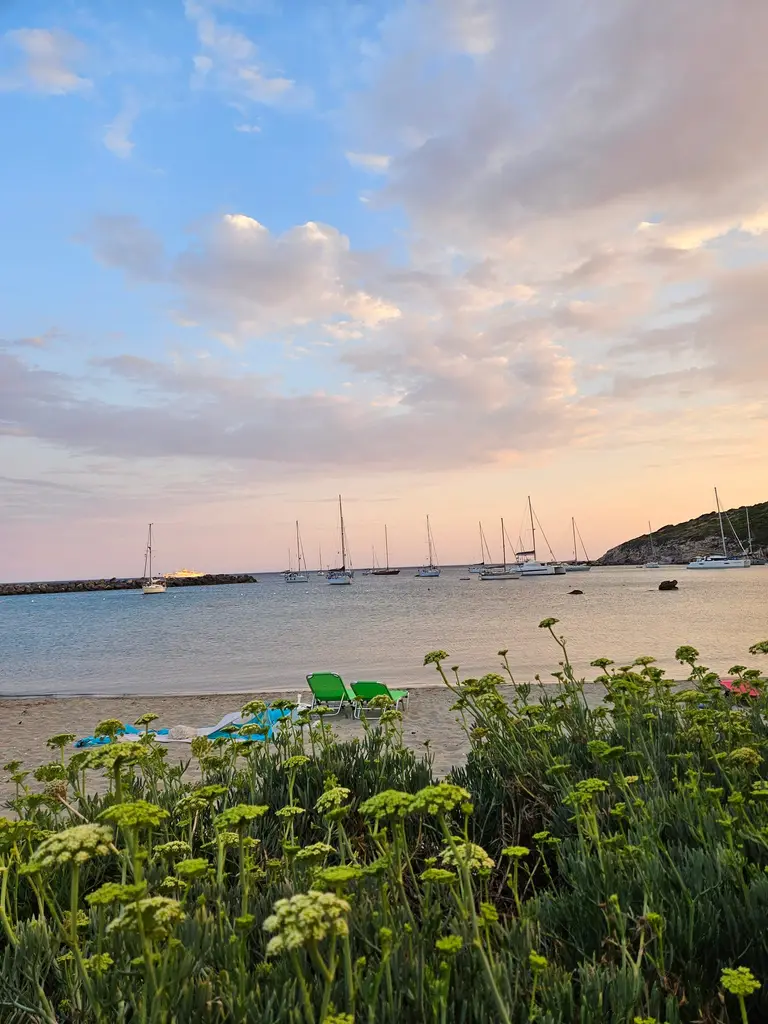
On the west coast of Othoni, next to Aspri Ammos, there is a sea cave with two entrances. People here have called it Calypso's cave for as long as anyone can remember. When the sea is calm, strong swimmers go in at the north entrance, come out onto the small beach inside where the light arrives from both ends, walk across, and climb down at the south entrance.
It is open. Not because anyone opened it — because it opens onto the sea, and always has.
You reach it by boat from Ammos, the settlement where the ferry arrives. On an island this size that is usually arranged the same morning. Go in the morning rather than the afternoon: the west coast takes the wind first, and it builds through the day.
Is Othoni really Ogygia?
Nobody can prove it, and we are not going to pretend otherwise. Ogygia is a place in a poem.
What is on the record is this. Homer puts it far to the west, alone in the open sea. Othoni is the westernmost inhabited land in Greece — the last thing before the open Adriatic, which is what a Greek sailor of that period would have understood by the farthest west. Wikipedia's article on Ogygia lists the candidate islands and records the modern Greek tradition identifying it with Othonoi, alongside the older Gozo tradition. And the cave here has carried Calypso's name locally for generations, long before anyone started looking it up.
That is what we know.
You are probably already on an Odyssey island
If you are reading this from Corfu, you are standing on one.
Corfu is Scheria, the land of the Phaeacians — the last place Odysseus stops before he finally gets home to Ithaca. Thucydides identified it as Corcyra, and that is the oldest surviving tradition about where Scheria was. The Phaeacians give him a ship and he sleeps the entire way.
So the two islands sit at opposite ends of the same story. Ogygia is where the journey stalls for seven years. Scheria is where it ends. They are about four hours apart by boat from Corfu Town, or an hour and a half from Agios Stefanos in the north of Corfu.
If you are here anyway, that is not a long way to go to stand in the other one.
Getting here: Othoni is reached only by boat from Corfu, and everything depends on the weather. Both routes, with real departure times, are on the timetable page. If you are weighing up a day trip against staying the night, we have written that out too — day trip or overnight?